
What happens to an inner experience the moment I communicate it?
Memories before I (and AI) is a relational art project in three acts, still under development. I explore memory, imagination and visual translation by bringing artificial intelligence into dialogue with painting and integrated digital projection.
From memory to words, from words to images, and ultimately to an encounter with another person, the original message undergoes continuous transformation. Between an inner vision and its representation lies a gap that no image can bridge, made up of interpretations, conjectures and misunderstandings. “Ceci n’est pas ma vision”: as with Magritte’s pipe, the image is not what it represents.
Act I · Memories before I (and AI)
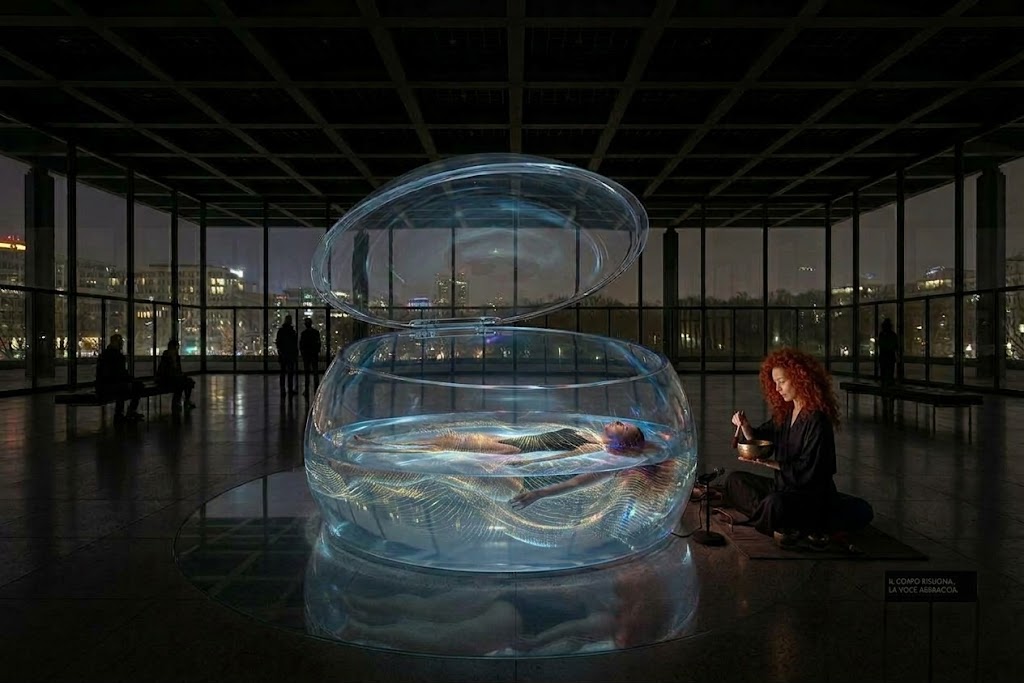
It all begins in a sensory deprivation flotation tank. A recording of my voice accompanies the participant on an imaginative journey backwards through memory, towards the threshold where individual identity seems to dissolve. Afterwards, the participant anonymously describes a single fragment that emerged during the experience. Those words are submitted to a generative model, which transforms them into an image.
Wittgenstein wrote: “The limits of my language mean the limits of my world.” This is what interests me: what I experience in silence is rich and complex, words convey only part of it, and the algorithm interprets only part of that part.
Act II · I See, I See… But I Can’t See
The generated images become part of an online exhibition. Visitors who know nothing of their original context choose one and write their own description of it. This description is then submitted to AI to generate another image.
A potentially infinite relational chain emerges, much like a game of Chinese whispers: I am no longer looking for the origin, but for the distance between one person’s gaze and another’s.
Act III · I Am in the Eyes That Are You
Here I return to matter: a painting with integrated digital projections, derived from a selection of AI-generated images that I personally rework.
The title contains the central question. When I look at you, I see what my eyes, my history and my expectations allow me to see of you, and you do the same with me. We do not simply have eyes: we are those eyes. Each of us encounters only an image of the other, and it is this that prevents truly complete communication and communion.
The experience culminates in a participatory performance dedicated to objective vision: a practice of breathing and non-interpretative observation that suspends perceptual filters. I previously explored this technique in 2020 at the Elisarion Cultural Centre and Museum in Minusio; here, it becomes an encounter with one’s own reflection in a mirror.
Having passed through a network of human interpretations and algorithmic generations, the gaze turns back to question itself.
The triangle closes upon three vertices: inner vision, the gaze of the other, and my own gaze.
In the mirror, for once, the eye encounters itself. It is no longer a matter of recognising the image I have constructed of myself, but of asking who is looking at it.
Who am I, before the image I have of myself?